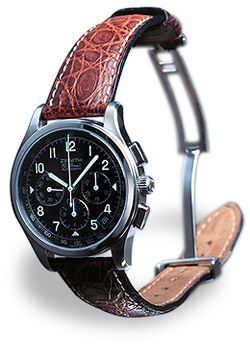
  I chose the Class 4 because of its El Primero movement and because I liked its appearance. The closest contender was the IWC Fleigerchrono auto, which is considerably more expensive. At the time I bought it, I was not aware of some alternatives that I'd consider now, like the Minerva Palladio.
I particularly like the dial. Instead of using bright white, Zenith used light gray for the hour/minute markers, the tachymeter scale, the subdial markings, and the logo text. The luminous Arabic numbers and hands are much brighter, which makes reading the time very easy. Because all of the smaller markings are slightly subdued, the dial does not have the cluttered look that many chrono dials suffer from, yet the light gray markings are very easy to read. I much prefer the classic and symmetrical 3-6-9 arrangement of subidals to the 6-9-12 arrangement of the stock 7750. The subdials have tiny steel bezels around them. 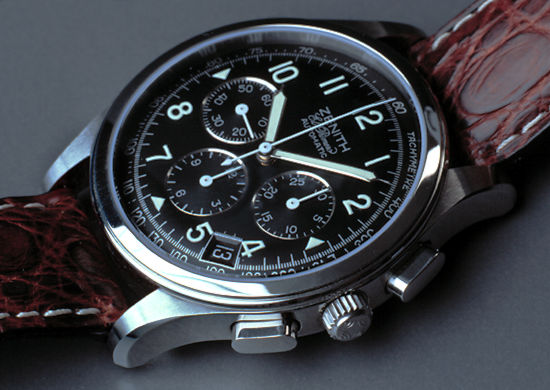 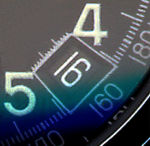 Notice that the date window interrupts the seconds/minutes chapter around the outside of the dial. However, the missing tic marks are still there, on the inside edge (towards the center of the dial) of the window. Notice that the date window interrupts the seconds/minutes chapter around the outside of the dial. However, the missing tic marks are still there, on the inside edge (towards the center of the dial) of the window.
Before seeing the Class 4 in person, I had thought that the location of the date window was odd, but it works really well when wearing the watch. With your wrist at a normal angle, you see the date straight on--you don't need to turn your arm. 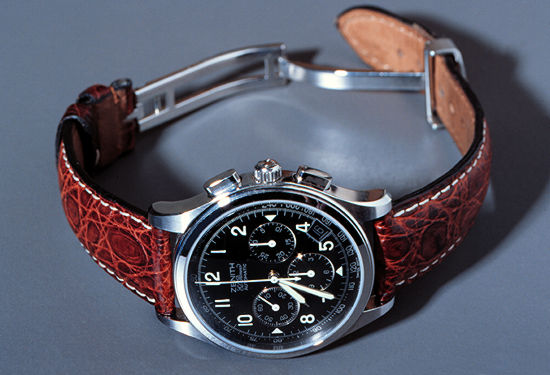 Everything feels tight and precise. The pushers operate with a silky push-click start and push-click stop. The center chrono hand with its 1/10 second jumps moves with an eerie smoothness. 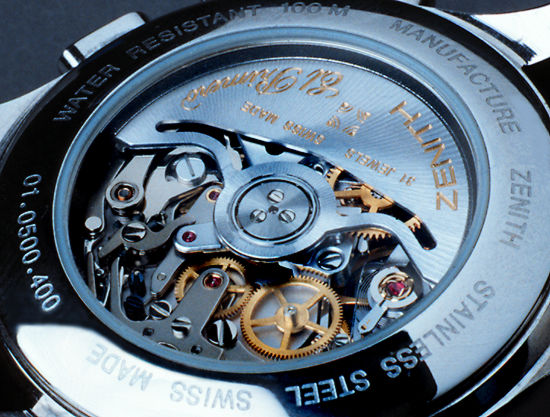 As Michael mentioned in his review, El Primero is neatly but simply finished. The first few days that I had the watch, I spent a lot of time with a loupe looking through the back while operating the chrono pushers. When I first got it, my watch ran about 30 seconds slow, but by the end of a week, it had settled down to running consistently at +3 seconds per day. The first few days the date changed at about 12:15 or 12:20 (I'm a night owl), but it now changes within about a minute of midnight every day. The rotor seems to wind very efficiently. Looking through the back, the rotor turns smoothly with the slightest movement of the case. I've had no problem at all keeping the watch wound when wearing it. The only times I've had to use manual winding was if I didn't wear it for a couple of days. If I had to wind it all of the time, I'd find the very small crown annoying. This watch does seem to run a bit fast as it gets towards the end of its power reserve--it can gain about 5 seconds in the last few hours. However, if I wear it every day, it keeps very consistent time. 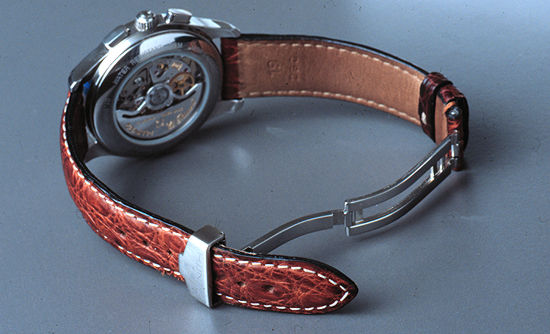 My Class 4 came with a leather strap, to which I added the Zenith deployant buckle. I've been very pleased with it. When changes in temperature and humidity make the strap slightly loose, the flat portion of the buckle keeps the watch from turning on my wrist. 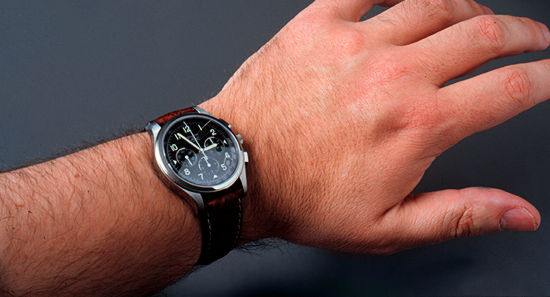 Although heavy compared to a non-chrono watch, the Class 4 is comfortable to wear, especially with the deployant buckle. At 12mm, it is thin for an automatic chronograph, most of which are at least 2mm thicker. Notice how well the hands and Arabic numbers stand out, and how the date window can be read comfortably at this angle. 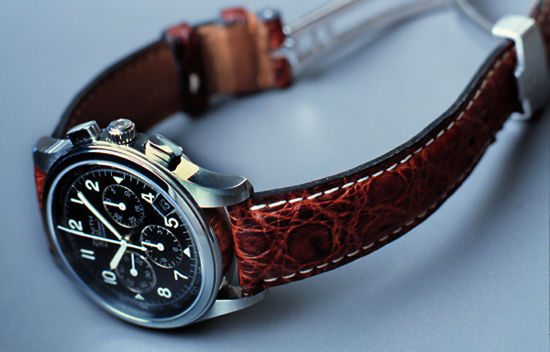  Although I have a small collection of vintage watches, I don't wear them often, to prevent further damage to them. I have four watches that I purhased new, which are what I wear most of the time--a Ventura v-matic auto, the Class 4, a Minerva Pythagore, and a Nomos Tangente (purchased in that order). I like these all for very different reasons--the Ventura and Nomos for their bold, simple designs, the Pythagore as a beautiful piece of classic horological art, and the Zenith as a clean and functional tool. They are a pleasure to own and wear, all for different reasons.
 email: paulsc@eos.net Michael's excellent Class 4 review and photos Review of the Zenith deployant buckle (on the Netbabbler Zenith forum) Back to the TimeZone Public Forum Text and photographs copyright © 1999 Paul Schliesser |